

Song meaning
What Neon Tears is saying
Neon gives sorrow an artificial urban brightness: pain is exposed rather than hidden, yet it can still be beautiful without making the lost relationship desirable. The flower growing from a wound and dawn breaking grayness mark a recovery that honors feeling while refusing to live inside it.
Images, symbols and language
Neon Tears works through contrast: the title image names a danger or burden, but also contains the material of release. Read alongside the title, the lyric's recurring objects and forces are not passive scenery: they measure who controls the space, whose voice can be heard, and whether the speaker is confined or moving. By the end, the metaphor has accumulated enough history to make heartbreak feel earned within the lyric's own terms.
The language also works through accumulation. Each return to the central image carries the pressure named in the verses, but the speaker's verbs increasingly emphasize seeing, naming, refusing, building, releasing, or rising. That movement keeps the symbol from having one fixed definition. It can retain the mark of danger while becoming a tool of perception, and it can acknowledge loss without making loss the lyric's final horizon. In that layered use of image, heartbreak, letting go and hope become parts of one visual argument rather than separate themes.
The emotional turning point
The first emotional movement holds recognition and resistance together, creating friction between remembered powerlessness and present speech. Heartbreak remains visible in the sleepless city, but its tears illuminate a route forward. Grief changes from evidence of attachment into a bright, honest guide toward release. The conflict has force because the speaker is not confronting an abstract obstacle; she is contesting a version of reality that has entered her habits, memory, body, relationships, or sense of duty. The repeated chorus gives that struggle somewhere to return, allowing conviction to gather instead of appearing complete at the start.
The last movement replaces compulsory endurance with deliberate response. Neon Tears makes letting go credible by showing the speaker choose what she will carry forward and what she will no longer serve. This emotional change is meaningful precisely because the lyric keeps the original pressure in view. The speaker's new position is not innocence restored, but a more exact knowledge of what happened and of what she can choose now.
Its place in Crown of Fire
From surviving emotional and technological forms of control to claiming identity, voice, and inner authority.
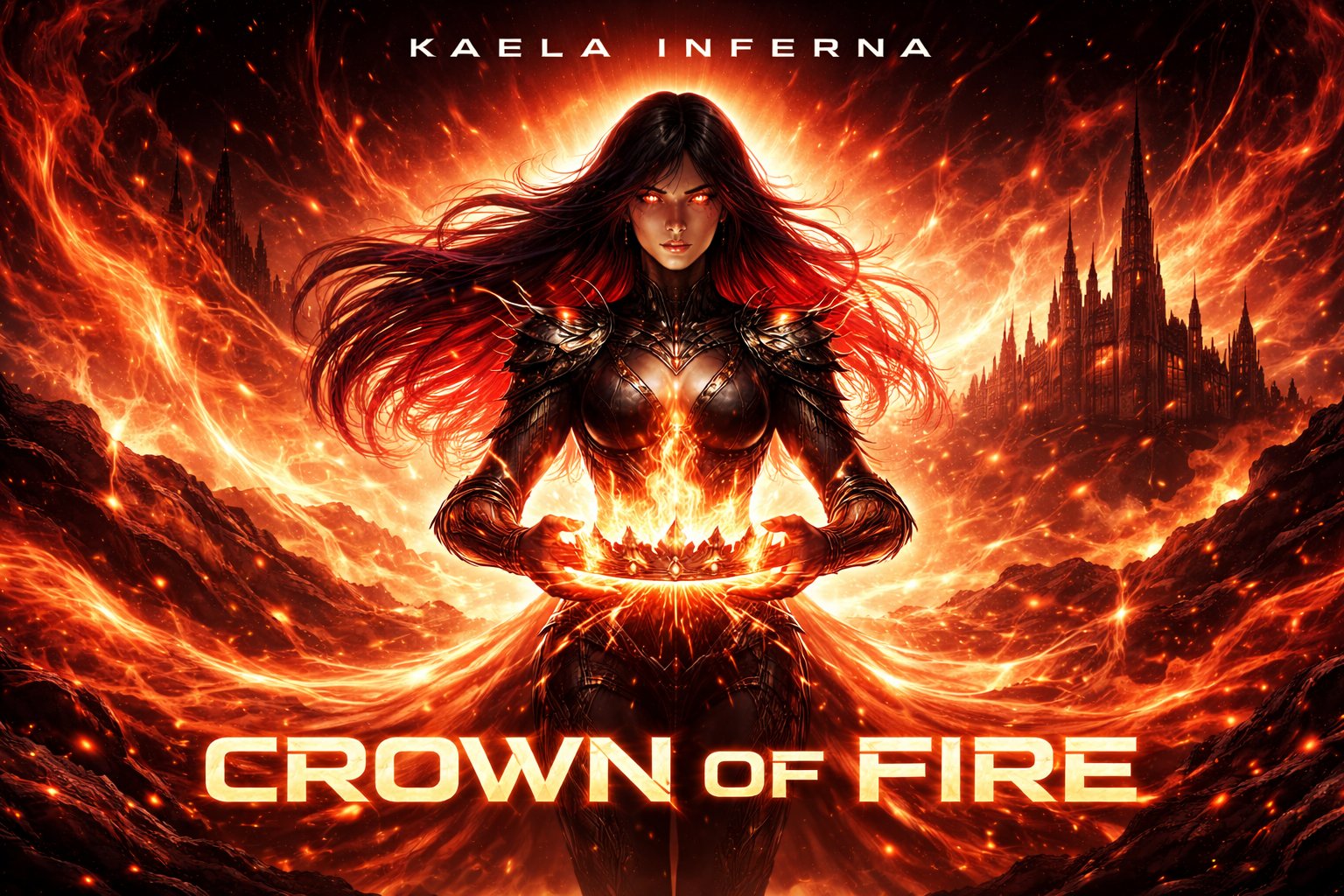
Placed at track 7 of 12, it advances Crown of Fire at the point where heartbreak must become more than an initial impulse. Within the album's arc—from surviving emotional and technological forms of control to claiming identity, voice, and inner authority.—this song concentrates on heartbreak, letting go and hope, giving the larger journey a distinct emotional task rather than repeating the album thesis.
It receives the unresolved energy of “Midnight Crown” and hands a changed version of it to “Phantom Glow.” The sequence makes letting go a bridge rather than an isolated lesson: the previous song supplies the pressure, while the next reveals what this track's decision enables.
Why this song matters
Neon Tears earns its resonance by treating self-trust as a decision with consequences, not a decorative affirmation. Its images offer a way to examine that experience without turning it into a diagnosis or an easy moral. A listener can recognize the tension between adaptation and self-erasure, or between memory and forward motion, while still leaving room for circumstances unlike the speaker's.
The song also understands that reclaiming language changes what choices become imaginable. To call a burden a burden, an illusion an illusion, a boundary a boundary, or a desire one's own is already to interrupt the old account. Neon Tears does not guarantee a painless future; it values the smaller but consequential act of believing one's perception enough to make a different next move.
Listen inward
Questions the song leaves behind
- Which image in “Neon Tears” changes meaning most clearly as the speaker moves toward heartbreak?
- Where does the lyric draw the line between letting go and the older pattern the speaker is leaving?
- How does this song's ending prepare you to hear “Phantom Glow” differently within Crown of Fire?